Description
About This Video
Transcript
Read Full Transcript
Hi, everybody. I'm Tom McCook. I'm back here at Pilates anytime. Really excited to be back for a few lessons. This is today and tomorrow, and I'm here with JD and with Aaron, and our lesson today is gonna be on the relationship between your foot to your hip. I've done a lot of work over the last few years, and it's just has been dramatic in how it's affected my own body and my understanding of how to work with people a little bit better.
So the first thing we're gonna do is just gonna feel our foot by doing a simple movement. We're gonna do is we're just gonna go like this. We're gonna go ball, ball outside, outside, heel, heel, inside, inside. And as you do that, let your knees soften. And you're wondering why is he having me walk like this? I'm having fun.
And I'm just doing the extremes of what happens in your feet to a smaller scale when your feet are adapting and dealing with the ground, and we're mobilizing our foot so it can feel a little bit more. So it's ball, ball, outside, outside, heel, heel, inside. And so now we're gonna reverse ball, ball, inside, inside, heel, heel, outside, outside. Ball, ball, inside, inside, heel, heel, outside, outside. And then just stand for a moment. Now let's just imagine that you have three key weight bearing points to stand on which relate to how you deal with gravity, your alignment, your spine, how all the muscles in your body works.
Your feet are really the first thing that dictate what happens above them. So I want you to lean down and touch behind the big Tom, we'll call that ray number one, the ball of your big Tom. Behind your little toe, the fifth metatarsal head, we'll call that point number two, and then imagine the center of your heel, and then stand back up. And imagine those are your three key weight bearing points in your feet that relate to how the feet absorb force, how the muscles above your feet, and your body moves through space. So let's just practice bending and straightening our legs. Just do a couple small bends And imagine when you bend, just feel what are my feet doing when I bend my legs? Do I feel like the feet are widening and lengthening, or do I feel like they're shortening and the arch is lifting?
And see if you can get a feel for that. Got a little sense happening there. Here we go. So see if you can sense that when you bend your legs, that the foot is flattening, and the forefoot is swiping out. And as you straighten, the forefoot is swiping in and the arch is lifting.
And just do that a few times. You can imagine like windshield wipers. When you bend, the windshield wiper swipes out, as you straighten the windshield wiper swipes in. The key thing while you're doing that is, is it possible for me to still feel my three weight bearing points? The heel, dig, toe, little toe.
So very simple. So I just wanted to get a simple feel for that. Now let me give you a little more information that goes to that. So here's your pelvis. We're the only animal on the planet that has a mobile pelvis. How far out is that? So when you bend your legs, the bottom of the pelvis widens, and as you straighten the bottom of the pelvis narrows. Let's do that a few times together.
So as you bend, Take your hands like this for a moment and imagine you're holding your pelvis like that. So as you bend, the bottom of your hands widen, and then they narrow and see if you can start to feel when you bend that the bottom of the pelvis is widening, the bottom of the pelvis is narrowing. So that motion is coupled with the widening and lengthening of your feet. Now just notice if you don't let the sit bones widen and bend your legs. No, really.
You'll notice that your hip flexion is impaired and your foot can't do the right thing. So that those two things go together, widening of the sit bones is related to good hip function, spine mechanics, leg alignment and how your foot is designed to absorb force. That's pretty cool. So that's just to give you a little more information. Now let me show you the foot so you get a little more feel of what that relates to.
Happen to have a spare foot with me. So here's the side view of the foot. So the driver of the bus of the foot changing when you bend your legs is the heel. So the heel does two actions. When you bend your legs, you can see how the heel will come closer to the ground, and the foot will flatten and lengthen. Then when you straighten, it domes up.
You can sense how there's a rolling forward of the heel, then a rolling back. So we don't tend to think about very much as the ankle is actually we tend to think about dorsey flexion of the ankle, which is this, when we bend our legs, but the front of your heel is doing what's called plantar flexion. The front of the heel comes close to the floor, as the foot flattens, and then it domes back up. So the heel is like a wheel rolling forward and down. That's it. So it rolls forward and down as you put weight on the foot.
Now, even really relevant to that, when you're looking at it from the front view, the heel goes like this. It rolls like this. It goes what's called eversion, like I mentioned earlier, these two front foot points, first ray and the fifth ray are important to keep on the ground. So when you bend your leg as the heel rolls forward, it also rolls in flattening and then doming back up. The key thing is you don't wanna lose this little toe point, so a lot of times when people say they overpronate their feet, it's actually a distorted foot. The foot has lost one of its key money making points, and you can't use the arches correctly, which allows you to eccentrically lengthen your muscles in your body, and then let them rebound into contraction.
Pretty big deal. So we're gonna do that on our body so we can feel that. So I just wanted to give you that feedback of the heel rolls forward and rolls in, and the forefoot swipes out and inverts the other way. You have the heel and the forefoot doing two different things at the same time. Pretty amazing design.
So we're gonna do that together. I'm gonna take this out of the way, and we're just gonna take our left foot forward like so. And I want everybody to take your left hand, imagine this is your heel. So now when you bend, when you shift your pelvis, towards your front foot, don't just go forward, take your center or mass, which is a little below your belly button, take it on a diagonal towards your foot and just image and feel that your heel is rolling in towards the midline, and then see that it rolls out. It rolls in, and it rolls out.
So I'm gonna mirror the foot. So here's the heel twisting in, and out. You guys sense that a little bit? Very nice. Now also, the heel, like I mentioned earlier, rolls forward.
Imagine it rolls forward and rolls in so there's this diagonal roll of the heel from the outer heel towards the inner heel, and you get a feel for that. There we go. Let's just do that two more times and one. Now let's add to that. Same side.
As it rolls forward, the inner heel rolls in and feel like the forefoot swipes out like a windshield wiper. And it swipes in, and the arch lifts. It's all happening at once, but you only have one hand, warm, warm. That's it. Now notice when you go forward that your center of mass is going towards your foot.
And the knee can come in a little bit. So the knee is designed not always stay lined up over the foot. It's reacting to what your pelvis and your foot are doing. See if you can sense that. Now go forward and just hold it there for a moment. Now notice, can you put weight on all three points, and keep taking your pelvis more forward.
And then come back. Let's do that one more time. Forward and back. Now let's try that on side too. And just take a moment, actually, before we do side two, just stand on that leg for a moment, stand on that side and bend and straighten the leg.
You can use the other toe on the floor if you need it for balance and just notice your stability and ability to be on the foot. In relationship to bending and straightening your legs, and compare that with the side we haven't done yet. You might notice this side feels a little more wobbly, a little denser, and not as connected. Do you agree? Very nice. So let's try side two.
So let's step your right foot, just small lunge for mankind, nothing big, and I have your right fist represent your right heel. And as you take your center of mass, towards your right foot, see the heel rolling in towards the midline. That's called eversion. As you go to straighten, it rolls out. So eversion is associated with knee and hip flexion, dorsey flexion of the ankle.
Now, also notice, can I go forward like that Keeping all three foot points, even though the foot is flattening and visualize the forefoot is swiping out, like a windshield wiper, so the foot is lengthening and widening? Then it swipes in the front of the heel lifts. As you go forward, the front of the heel rolls down and in, and then it rolls back. Play with that. And what you'll might notice, what I found is that when we think of that we have weak ankles, what we really have is an inability to stay on our foot points while the foot is changing, and moving our center of mass correctly over our legs while we're moving through space. We live in a very linear world, and we've been we've kind of committed to moving in a linear way.
One more. Very nice. Now just take a moment to stand. Now come back to your first side. Now this time, let's let's notice what happens when we supinate the foot. So let me I'm gonna come back to my foot model for again, so you can see this.
So when you supinate the foot, when you're straightening your leg, the inner heel, the front of the heel lifts, and the forefoot turns down into the big toe. So I'm going from super pro nation where the arch is stretching, the foot is flattening, to supination where the arch is lifting, and I'm turning down into the big toe. So this is relevant to hip extension. So you'll see hip extension is driven by your foot. Now let's show that let me show you the first from the front view. So from the front view, when my foot is supinating, the the heel is rolling out.
It's inverting and the forefoot is everting down into the big Tom, but both front foot points stay on the floor or it's a $50 fine. There we go. That's it. So we're gonna play with that while we're we're gonna focus on the leg that's back now when we're in the lunge position. So here we are. So now we'll take the left foot forward.
Being a really small lunge, maybe a foot front to back and about six inches left to right. Now just practice when you take your center of mass towards your front foot, feel the front leg, the heel, evert, turning in, and the front foot swipes out. Just feel that. And I feel like you're on your foot and that front foot is is, stretched. Now while you're here, put your attention on the back foot. Press into the two front foot points and only lift the heel a really small amount, really small, and fully straighten the leg.
Now notice when the heel inverts, it drives the whole leg rotating out. The key thing is you don't wanna lift your heel really high. Leave that little toe point on the floor. That's your money point. Keep that and then lower the heel.
So when you go to lift your heel, feel like the heel, you can practice that with your right hand, will represent your right heel, the heel inverts, and the arch lifts. Now hold that and see your forefoot is turning down into your big toe because that's your push off point. Now hold that. Notice when you press into those front foot points and the leg turns out, the glue to mat immediately turns on. Now just as a as an aside, try, lose your little Tom point.
So now you're pronating when you should be supinating and notice how you can't fully straighten the knee very well, and the glutes gone. So hip extension without the foot ain't so good. So let's try that one more time. So as you lift the heel, feel the heel, invert, feel the forefoot turn into the big toe, and feel that lifting and that turning out of the heel drives the whole leg turning out so you can feel your glute turn on. You guys feel that? So that's directly related to every step you take in gait.
Let's try the other side. So first thing, just we'll set it up where your small lunge front to back, six inches left to right, take your center of mass towards your front foot Tom feel the front heel, your right heel, ever turning towards the midline, and rolling a little bit forward, then feel the forefoot swipe out. And just hold it there. So you're on a stable base put your attention on your back leg. As you lift the heel, just an inch, feel your lateral foot point, and your big toe point.
And imagine that your heel, you can have your left hand represent your heel now on your left side. The heel is gonna invert, and the forefoot turns into the big toe. Now fully straighten the legs, it might want to bend if we're tight in our hip flexors. Now let that ankle action turn the pelvis back to the left and feel how your glute turns on. Now just lower the heel and do that a few times.
Feel how you can drive into your foot, drive into the big toe as you lift the inner heel. Now you're working on the mechanics from your foot to your hip, related to what we do probably more than anything else, which is to walk. That's pretty cool. One more. And then let that go.
Take a moment. Now let's just do our basic bending and stretching. Will come from the pelvis to the feet. So when you bend, sit bones widen, sit bones narrow, sit bones widen, sit bones narrow, heal, inverts, or inverts, inverts, inverts, inverts, four foot swipes out, four foot swipes in, four foot swipes out, four foot swipes in. Now, bend and hold. So as your pelvic floor is lengthening, because your sit bones are wide, your foot is eccentrically lengthening.
So your foot and pelvis do the same thing at the same time. That's how the absorbed force, bottom of the pelvis, bottom of the foot, when we're standing on two legs and squatting. That's pretty cool now when you straighten, see the sit bones narrow, see the arch starting to lift, and let that take you up onto your ball of your feet. Lift the heels, the heel inverts, turn down into your big toe. Now as you lower, the heel rolls in, the forefoot swipes out, swipes in, inner heel lifts, sit bones narrow. That's a lot of information.
And again, inner heel rolls in, forefoot swipes out, swipes in, sit bones narrow, inner arch lifts, and rest. Very nice. Now just take a moment, do a couple knee folds, We're just gonna do one more thing standing, then we're gonna do two exercises on the reformer. So first thing now I want you to do is we're gonna do what's called a clock step. Imagine you're standing inside of a clock and you're in the middle, and what we're doing is giving our brain feedback that it wants to explore more ranges so our brain can pick a better choice by choosing more options than we typically do in our life. So it'll look like this.
As you bend your left leg, you're going to reach your right foot to number one on the clock, which is in front of you. Now feel how your foot is in pronation now on your left foot. As you straight and feel the arch lift, now reach for number two. Let the knee do what it needs to do. Don't put any weight on the leg you're reaching towards.
Keep all the weight on the standing leg. Come back up. Reach to number three. Reach to number four. As you reach to number five, let the pelvis turn. You keep looking forward to feel how the arch is lengthening more.
Keep your three foot points. That's your challenge. Come all the way up. Number six, pelvis turns. Keep your head straight ahead. This is a little more challenging.
Come back up. Now reach behind to number seven, Back up, reach to number eight, back up, reach for number nine, reach the right hand forward as a counter. Come all the way back up. So we're gonna do one through nine. Now we're gonna go through side two. So it's side two.
Left foot towards number 11. Feel your foot of the standing foot flattening, swiping out. Back to center arch lifts, number 10. Number nine. Load on to that foot. Number eight.
Back to center. Number seven, let the pelvis turn, but keep the weight on your foot. Number six, keep looking forward. Number five. Number four, the elusive four, number three.
Back up, take a moment Tom a couple knee folds, Notice your weight bearing, and we'll call it right there for now before we get onto the equipment on the reformer. Thank you. So here we are on the reformer, Aaron and I, and Aaron's gonna do a little work on the jump board. The first thing we're gonna do is we're gonna apply the lesson that we did standing to simple bending and straightening. So it's just gonna start with your legs straight. And when you do this on your own right now, we have on a red and a yellow, doesn't have to be very heavy. And I recommend you have your feet a little higher up on the board so you'll get more range without the heels coming up when you bend your legs.
You want to leave the heels flat. That determines your range. So the first thing all I wanted to do, Erin, is when you bend, just take your hands like this again and imagine here's your heel. And when you bend both of your legs, see both heels everting rolling in towards the midline and just hold it there and just sense that your foot is flattening and the forefoot is also swiping out. And as you straight and see the heel rolls out and the arch lifts.
And just do that a couple Tom, nice and smooth like that, and I'm gonna give her feedback of when the heel is rolling in, the forefoot is swiping out, it swipes in, it rolls out. So basically, and I'll mirror it from here as she bends the forefoot swipes out, and then it swipes in one more. Now take your hands and mirror what the pelvis is doing. Take your hands like this. Now the pelvis, like we mentioned, when we were standing, the sit bones widen when you bend your legs, the sit bones narrow.
So these movements are all coupled. The arch flattening as the pelvic floor lengthens happening altogether. So the foot is widening and lengthening, narrow and lifting. Now do one more. Now, when you feel the sit bones narrow, straighten the legs fully, Now feel as you lift the heels, the inner heel comes up the inseams, but you're pressing into that big toe without losing the little the the the lateral side.
And again, lower the heels, bend, foot flattens, straighten, inner heel lifts, four foot turns down into the big toe. Take it nice and slowly. I'm gonna do two more before we take it into a jump. We're getting ready for a party. That's it. And then straighten and lift.
That's it. So this is this is now your body using three dimensions to absorb force. Pretty cool. One more. That's it. Now, imagine when you straighten straighten and hold it there for a moment. So imagine what just happened when you go ahead and lift the heel. When you lift your heel, feel like the heel is rolled back, and inverted, and now feel how your sit bones are narrow.
Now when you lower the heels, feel the sit bones widen, the front of the heel drops forward. Now, jump by rolling your heel out and narrowing the sit bones. And then widen to land. Narrow to the lift, widen to land. Feel as the foot is widening, the pelvis is widening, and that's absorbing, then transferring into the next jump.
Nice and fluid. That's it. And only low to the degree the heels don't come up. So you can feel how you're absorbing, you're decelerating two more like that. That's it. Think of the jump is really more about the landing because we wanna decelerate well. So our body becomes strong and fluid and works with gravity better. One more.
And then rest. And this relates to jumping on single leg, turnout. The foot action is always the same, whether you're in turnout or you're parallel. This worked just for a little incidental thing. This changed my foot. I had a neuroma in my right foot, injured with, fire out of my third toe for three years.
And when I took the anatomy emotion course with Gary Ward, where I learned about this stuff. There's a book called, what the foot? I learned how, what the foot question mark. I learned actually through the course, how Tom, how the the design is designed to absorb force and move through gravity, and I really highly recommend it play with this stuff, and we have one more exercise before we continue. Okay. Now we've made a little equipment change.
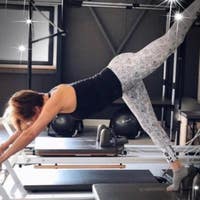
What we're doing now is a hip hip extension exercise that's tied into the foot and the hip based on what we've been doing so far. So we put the long box, and I put it over the shoulder blocks against the steel bars, so you have a little more room, and it won't slide when you're in position. We have it on, middle bar, and one red and one yellow, You can always go heavier, but I recommend start lights, which not too much on your shoulders when you start. So, Aaron's gonna come in on her forearms facing the box in a kneeling position, and then put her left heel on the bar. So right now, just naturally when she's in, because her hip is flexed, her knee is flexed, and her ankle is flexed, her foot is in pronation, meaning the inner part of the heel is closer to the to the bar. So it's everted. Now when she straightens your leg, I want her to fully feel it straight and now feel the heel invert and notice how that drives the whole rotation of the leg and it feels the glute fire.
You've sensed that a little bit. There you go. And then as she bends, she's gonna let it pronate, fully straighten, feel the heel roll out, feel that drives the whole line of the leg and the hip. There's a little bit of a pelvic rotation towards the ceiling on this side just like if you're walking. And then she'll come in again, fully straighten, heal rolls. So this is what's important about this, which I think is critical to all of us, is that if you have a client, who has weak glutes and you don't tie their glute work to their foot.
You didn't do much for their glute because their glute needs to fire in relationship to how their foot is meeting the ground and turning on the whole line. That's a big deal. So if I just have somebody do 6,000 bridges and their butt gets huge, that's pretty cool, but then they still walk badly. Hate that. So you have to kind of put that in to tie that together. Now when she comes in, now now we're gonna have her do it on the ball of her foot.
Same action. That's it. Now make sure when you're on the ball of your foot that it's low enough that when you straighten, you can get the fifth metatarsal on the bar. I'm gonna even lower it a little bit more because I don't care about the toes so much. I want the first and the fifth on the bar. Now fully straighten, hold it now. Let the heel be a little lower. Now feel the the heel is inverting, the forefoot is turning into the big Tom, and you can feel the whole line.
You can even see her glute activate, and then bend, and watch for yourself that when you straighten, you don't go up into high heel right away. That's the default. When you're walking, that's like the last thing that happens in this very little pressure on the foot at that last moment. So feel the heel inverts, the whole leg turns out, the forefoot turns down into the big toe. Then you got great pressure for leverage.
We need leverage in our feet for them to work correctly. There you go. Beautiful. And I would do both positions, heal, and ball of the foot, and you can play with that dynamic. Both sides, again, you we started with a red and a yellow, but you can play around with the weight, but just get the mechanics first. Then we're gonna slowly step off.
Nice work. Thank you, Aaron. So why is this important? So we've done all this work in Pilates and movement on the dynamics of the whole body, but we've we're still catching up with the foot. But the foot is the first thing that absorbs force when you move. The bone changes in your foot are all gravity driven.
They're not muscular driven. Change just from putting weight on it, and it dictates what everything up the chain is gonna do optimally. So we're just including three-dimensional feel of the foot, which improves your knee function, your spine function, and there's about a 100 more things that I could say, but it's really, really important, and I think you'll enjoy it and feel the difference when you play with it. Thank you, everybody. Great to be here.
Hope to see you again.
The Teacher's Corner: Embrace How You Teach


Comments







You need to be a subscriber to post a comment.
Please Log In or Create an Account to start your free trial.